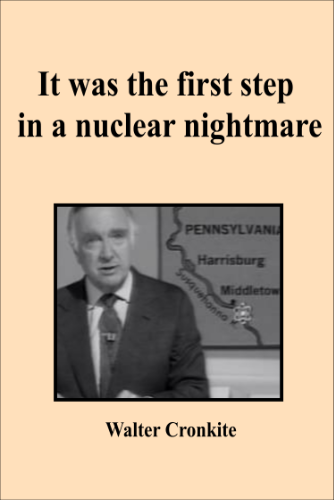
July 16, 2025: The Water Cost of Electricity on the Susquehanna River

May 15, 2025: Data Centers and Nuclear Power on the Susquehanna River: More Questions than Answers

Sep 29, 2024: The case against restarting Three Mile Island’s Unit-1


Radioactive: The Women of Three Mile Island

Did you catch "The Meltdown: Three Mile Island" on Netflix?
TMI remains a danger and TMIA is working hard to ensure the safety of our communities and the surrounding areas.
Learn more on this site and support our efforts. Join TMIA. To contact the TMIA office, call 717-233-7897.


US to Own Nuclear Reactors Stemming From Japan’s $550 Billion Pledge

Story by Ari Natter and Will Wade • 3 min read

A cooling tower at a nuclear station in Scriba, New York.© Bloomberg

(Bloomberg) -- The US government plans to buy and own as many as 10 new, large nuclear reactors that could be paid for using Japan’s $550 billion funding pledge, part of a push to meet surging demand for electricity.

The new details of the unusual arrangement were outlined Wednesday by Carl Coe, the Energy Department’s chief of staff, about the non-binding commitment made by Japan in October to fund $550 billion in US projects, including as much as $80 billion for the construction of new reactors made by Westinghouse Electric Co.

“The role of having the government involved in private markets is sacrosanct — you just don’t do it,” Coe said at an energy conference hosted by the Tennessee Advanced Energy Business Council. “But this is a national emergency.”

The Trump administration has sounded alarms bells about a shortage of electricity needed for energy-hungry data centers that power artificial intelligence and for a potential resurgence of domestic manufacturing.. On his first day in office, President Donald Trump declared an energy emergency, unlocking new domestic powers to fast-track pipelines, expand power grids and save struggling coal plants. 

It has been more than a decade since the US last broke ground on a large-scale nuclear power plant that came online. Most of America’s energy industry wrote off for dead the notoriously expensive projects after Southern Co., the last utility to build a new plant, went $16 billion over budget and seven years behind schedule building its Vogtle project.
Related video: America's $35 Billion New Nuclear Power Plant (MegaBuilds)

MegaBuilds
America's $35 Billion New Nuclear Power Plant

Still, the AI boom has created new life for the big plants. Earlier this year, Xcel Chief Executive Officer Bob Frenzel raised the idea that the projects could come back in vogue.

It is still unclear whether the funding commitments made by Japan, announced last month as part of a trade deal framework with the US, will come to fruition. In all, Japan has agreed to invest some $332 billion for energy projects in the United States, according to the White House. That pledge, in addition to Westinghouse’s new AP1000 reactors, include a new breed of smaller nuclear reactors, as well new power plants, electric transmission projects and pipelines. 

The Trump administration’s energy ambitions include orders aimed at accelerating the construction of nuclear power plants and government funds to support the restart of shuttered nuclear plants. An executive order aims to get 10 large, conventional reactors under construction by 2030, a target the industry has said will be challenging, but possible.

Shares of Oklo Inc., a US developer of small modular reactors, rose on Wednesday following Coe’s statement. Its stock was up 6% at 1:57 pm in New York. Shares in Canadian uranium miner Cameco Corp. rose as much as 5.7% and were up 3.3% at 1:57 pm in New York. 

The Energy Department didn’t immediately respond to a request for more details. Coe, in his remarks at the conference, said lots of details remained to be decided, but expressed confidence the nuclear reactors would come through. 

“We’re trying to decide where to put them,” Coe said.

Democratic Wisconsin lawmakers propose legislation capping utility bills

Bill would essentially cap residential utility bills at 2 percent of household income
 
By   |  

A grid of electric utility meters and labeled black circuit boxes mounted on a gray panel, each meter displaying numerical readings.
In this May 6, 2009 photo, watt-hour meters track electricity used by residents of an apartment building in St. Marys, Pa J. Scott Applewhite/AP Photo

Wausau resident Jill Sexton and her husband are both in their 60s. Sexton says she’s on disability and her husband is on Social Security. 

Sexton said she had to take a part-time job to cover rising utility costs, but it’s still tough to make ends meet.

“Each month, we choose between paying the electric bill and heat bill or filling our prescriptions,” she said at a recent news conference. “Some months, I don’t buy the medication. Some months, we stretch food until the very last day.”

Democratic state lawmakers are proposing a bill that they say would address the issue.

At a Nov. 11 press conference, state Reps. Darrin Madison of Milwaukee, Francesca Hong of Madison and Ryan Spaude of Ashwaubenon announced legislation that would essentially cap residential energy bills in Wisconsin at 2 percent of household income.

The bill would require the Public Service Commission of Wisconsin to create a percentage of income payment program that would provide relief to energy burdened or severely energy burdened households.

The legislation defines energy burdened households as those spending between 2 and 4 percent of their household income on electricity and gas bills, and severely energy burdened households as those spending 4 percent or more.

Spaude said the bill is “all about affordability.”

“Folks in my district and around the state are on a knife’s edge,” he said. “Many of them are just barely getting by. This bill is going to do something. It’s going to keep more money in their pockets.”

A woman speaks at a podium with multiple microphones during a press event, with several people standing behind her in a wood-paneled room.
Jill Sexton of Wausau speaks at a news conference about legislation that would essentially cap utility bills. Screenshot courtesy of WisEye video

The Wisconsin Utilities Association declined to comment on the proposal.

Tom Content, executive director of the Citizens Utility Board of Wisconsin, said his organization hasn’t taken a position on the bill yet but said he appreciates that it shines a light on rising energy costs.

“At this time of the session, there are a lot of bills that are introduced for messaging rather than for enactment,” he said.

Democrats nationally are trying to make affordability and cost of living issues a central campaign issue. Democratic candidates who won elections this month in New York, New Jersey and Virginia all made affordability a core component of their messaging.

The Democratic bill would need bipartisan support to reach Gov. Tony Evers’ desk.

“Given that the Republicans control the state Legislature by a good margin, and that this is a Democratic bill, I would say it strikes me as unlikely to become law unless there are some Republican co-sponsors,” said Michael Kraft, an emeritus professor of political science and public affairs at the University of Wisconsin-Green Bay.

Electricity prices expected to continue rising through 2026

Nationally, retail electricity prices have outpaced inflation since 2022, and are expected to continue rising through 2026, according to a May 2025 analysis from the U.S. Energy Information Administration.

“Right now, we’re in a period where electricity prices are actually the ones, I think, driving inflation,” Content said. “For all the attention that egg prices got last year, the price of power is what is really taking hold this year.”

Increases in average monthly residential electric bills in Wisconsin stayed below inflation from 2014 to 2024, the most recent year with available data, according to federal data. During that period, average monthly bills rose from $94.88 to $110.87. The U.S. Bureau of Labor Statistics inflation calculator shows $94.88 in December 2014 money had the same buying power as $127.53 in December 2024.

During the same period, the average price per kilowatt-hour — the cost of one kilowatt of electricity used for one hour — in Wisconsin has risen by nearly 26 percent, federal data shows. The average price per kilowatt-hour rose from 13.67 cents per kilowatt-hour in 2014 to about 17.18 cents per kilowatt-hour in 2024.

Electric bills can also vary by utility. For example, We Energies’ average electric bills in 2014 and 2024 were slightly above the statewide average, while Wisconsin Public Service bills were slightly lower than average, according to data from the Citizens Utility Board of Wisconsin.

We Energies’ average monthly residential electric bill was $99.65 in 2014 and $127.29 in 2024, while Wisconsin Public Service’s average residential electric bill was $83.94 in 2014 and $105.13 in 2024, according to the Citizens Utility Board of Wisconsin.

A sign on a grassy area reads We Energies Oak Creek Site with a list of facilities and the address 10800 S. Chicago Rd. Blue sky and trees are in the background.
A sign for We Energies’ Oak Creek site, home to its Oak Creek Power Plant and Elm Road Generating station is seen from the road. Evan Casey/WPR

Brendan Conway, a spokesperson for the parent company of We Energies and WPS, said in an email that the company’s typical customer bills are below the national average and in line with other utilities across the Midwest. 

“Our rates since 2020 have increased below the rate of inflation and we work every day to keep bills as low as possible,” Conway said. “Just this fall we returned nearly $70 million to customers through bills credits for fuel cost adjustments.”

Maria Beltran, a We Energies customer who lives in Milwaukee, said at the press conference that she struggled with energy bills when she was raising her children. She said her family often had to endure months without electricity and heat.

“The help that exists is slow, confusing and hard to access when you are already juggling with rent and shut off notices,” she said. “There is so much red tape (and) so many barriers that keep people in poverty oppressed. That is not right.”

Cost-conscious utilities resist Trump’s push for nuclear revival

By Brian DabbsFrancisco "A.J." Camacho | 11/18/2025 06:52 AM EST

The administration has yet to convince major utilities to commit to building large reactors again.

The Trump administration wants to churn dirt on a bevy of new nuclear power plants.

Electric utilities that power America have different plans.

Despite forecasts for spiking electricity use and pledges from the Department of Energy to bolster nuclear power, utilities aren’t inking contracts to build new plants with the large-scale, light-water reactors that have fueled American homes and businesses for decades.

“I wouldn’t build a nuclear plant,” Exelon CEO Calvin Butler told CNBC last week. “What I could do is lean in on combined-cycle gas turbines. What I could do is build community solar. What I could do is own battery storage.”

Duke Energy, a major utility in the Southeast, is now hedging after laying out loose plans in October to produce more than a gigawatt of new nuclear power by 2037.

“We still need to figure out what we’re going to do with cost overrun protection and how we’re going to protect our investors and our customers from overruns,” Duke CEO Harry Sideris said on an earnings call earlier this month. “Nothing going forward until we have those other items resolved.”

That hesitation is throttling Trump administration plans to reassert U.S. nuclear leadership globally — and to ensure there is enough power in the U.S. to win the artificial intelligence race with China. Experts say new builds are important drivers of industry advancement that will cut costs and boost innovation. They’re also needed to keep powering America with nuclear energy, as many of the 94 reactors in the U.S. near retirement.

“There’s not a single company out there talking about a brand new light water reactor, and that’s where the administration gets frustrated,” an energy lobbyist, who has close ties to administration and was granted anonymity to speak freely, told POLITICO’s E&E News. “The administration is a little tone deaf in understanding the trepidations from a Wall Street standpoint.”

The utility sector is grappling with a laundry list of nuclear concerns. It’s worried about high costs, hits to balance sheets and the availability of enriched uranium in the U.S. following a cut-off from Russian imports in 2028. Utility CEOs are also skeptical that the capital-intensive power will be needed if demand forecasts contract.

Nuclear construction is one of many areas of discord between the White House and utility sector.

Meanwhile, nuclear power is taking off elsewhere around the globe. China is building dozens of new large-scale reactors and dramatically cutting costs to build plants, according to recent academic research out of Johns Hopkins University, Harvard University and other institutions.

Federal support

Late last month, the Trump administration and reactor developer Westinghouse announced a “strategic partnership” to build large nuclear plants. The agreement gives the government the option to invest $80 billion into building new U.S. Westinghouse reactors in exchange for profit sharing,

While critical details remain unclear, like which utilities will purchase the power, the investment pledge is the culmination of months of rhetorical boosts for nuclear power.

“I’ve heard about the nuclear renaissance for 20 years,” Energy Secretary Chris Wright told the Foundation for American Innovation’s gala last week, according to POLITICO. “We are all in to make it happen, and with all of your help, we will make it happen.”

Meanwhile, DOE is looking for ways to help finance domestic uranium enrichment. And the administration has called for reform and expedited approvals from the Nuclear Regulatory Commission, which is tasked with ensuring nuclear safety.

In a statement, DOE spokesperson Ben Dietderich said the administration has “taken historic action to accelerate next-generation nuclear deployment,” pointing in part to a DOE loan to restart the Palisades nuclear plant in Michigan. That financing was initially approved by the Biden administration.

Some other new nuclear activity is afoot in the U.S. utility world. In September, the Tennessee Valley Authority, a federally owned utility, signed an agreement with ENTRA1 Energy, a developer of small modular reactors. Meanwhile, other companies are signaling interest in restarting shuttered plants and completing work on partially-constructed ones. Last month, Santee Cooper approved a nonbinding letter of intent to finish construction at the VC Summer nuclear station in South Carolina.

High cost, high risk

The sector remains traumatized and skittish after sky-high cost overruns tied to construction of the Vogtle nuclear expansion in Georgia, completed in 2024 at roughly double the anticipated price tag. In 2017, South Carolina’s Santee Cooper and a project partner also abandoned two Westinghouse reactors at VC Summer after sinking $9 billion into the project.

“They don’t want to get caught the way that the Vogtle utilities and developers were,” said Advait Arun, senior associate for capital markets at the Center for Public Enterprise. “They’re weighing the odds.”

The Vogtle cost overruns sent Westinghouse into bankruptcy and created a public relations nightmare for Southern Co., the parent company of Georgia Power, which purchases power from Vogtle.

Dale Klein, a former NRC chair, said that utilities remain cautious.

“Utilities, by nature, are going to be conservative, and they’ll do what’s cheap, reliable, and quick,” Klein said. “There are a lot of memoranda of understanding that are being signed today, and MOUs are only worth the paper they’re written on. It just means they’re going to agree to work and think about things.”

He said the decision to contract a new nuclear plant could deliver a blow to the stock price of the company.

“If a publicly traded utility was to announce that they’re going to build a new large, conventional nuclear reactor, it’s very likely that their stock price would drop because Wall Street would be worried about the risk,” Klein said.

A nuclear fiasco akin to Vogtle could upend the balance sheet for a small or moderate-sized utility, experts said.

Overruns didn’t upend Southern Co.’s balance sheet because the utility was able to pass upfront costs onto ratepayers. Now, other states are aiming to get laws on the books, known as construction work-in-progress rules, that allow their utilities to do the same. A bill in North Carolina attempts to do that. A recently passed bill in Missouri allows utilities to pass on costs, but only for new gas projects.

“[Utilities] have to consider what’s right for the ratepayers, and that’s going to be the first big question,” said Rowen Price, a policy adviser at the center-left think tank Third Way.

But with electricity prices rising nationwide, the public utility commissioners that regulate the utility sector could thwart plans for rate hikes.

“If a utility wants to build nuclear, they have to be very careful in how they approach PUCs,” Arun said. “In light of broader concerns about affordability, we shouldn’t assume approval of rate hikes as granted, at least not to the degree that they could finance nuclear.”

Critics of nuclear power are relishing the inaction among utilities.

“We’ve seen these so-called nuclear renaissance efforts declared in the past,” said Kevin Kamps, radioactive waste watchdog at the nonprofit Beyond Nuclear. “It’s such a horrendous recent experience, no wonder the utilities aren’t gung-ho to jump in if any of their own skin is in the game.”

Demand spike uncertainty

The United States faces an electricity demand surge unseen in a generation. But some experts think the forecasts may be overblown. Data center developers are logging potential projects in multiple locations across the country, and that’s added uncertainty to the infrastructure build-out. Moreover, data centers could become more efficient and the pace of the tech industry could slow.

Experts compare the current demand scenario with the dot-com era, when dramatic electricity demand spikes were projected but never materialized.

“If there is a sharp contraction in demand, the projects that will go first are the largest capital investments with the least flexibility value in the future,” Arun said. “You’re going to see a lot more investment in cheaper gas, solar and storage and batteries, and wind — these kinds of technologies.”

Moreover, the highest confidence for skyrocketing power demand forecasts is in the next few years.

“When you look at that demand that you have to meet right now, that means natural gas is about your only choice for 24/7 operation,” Klein said. “They’re building these data centers now. They need electricity now. Nuclear takes longer.”

Still, Klein was hopeful that utilities will invest in nuclear projects today to meet long-term forecasts, which still predict continued growth. That could help provide investment confidence.

“If the data centers come in with money up front and say, ‘I will guarantee I’m going to buy this electricity for the long term, and I’m willing to be risk-sharing,’ then I think you’ll see some plants being built,” Klein continued.

Edison Electric Institute, the main lobbying group for for-profit utilities, says it supports nuclear.

“Nuclear energy is essential to delivering as many electrons to the grid and providing more reliable energy to the American people as affordably as possible,” EEI CEO Drew Maloney said in a statement. “We welcome the Trump administration’s focus on revitalizing this sector and look forward to working together to power America’s future.”

But to boost nuclear energy, utilities will need to move beyond rhetoric. Experts say the Trump administration’s $80 billion pledge is merely pomp until utilities get involved.

“It’s all kind of holographic until someone actually buys a reactor,” said the energy lobbyist granted anonymity to speak freely. “Who’s going to buy the reactor? Until your acme utility actually signs a contract, it’s irrelevant.”


Finally Some Accountability for Georgia’s Costly Nuclear Power Mistake

By Kim Scott

The story of Plant Vogtle’s two new nuclear reactors in Georgia is not a triumph of a “nuclear renaissance”; it’s a cautionary tale written in soaring electric bills and a growing political fallout. The people of Georgia are paying the price, literally, as their utility bills have skyrocketed by over 40% – and now, following last Tuesday’s Public Service Commission election in Georgia, it seems those that allowed this to happen in the first place are starting to feel the pinch as well. It’s about damn time! 

Georgia voters delivered a stunning message by unseating two Republican utility commissioners, Tim Echols and Fitz Johnson, who rubber stamped and championed the costly mistakes leading to a 41% increase in Georgians’ electric bills. This election, which saw Democrats Alicia Johnson and Peter Hubbard championing fair rates, affordability and renewable energy, was a clear referendum on Plant Vogtle’s enormous price tag and more importantly, nuclear power as a not so clean future power resource both here in Georgia and elsewhere. 

The stunning defeat of utility backed incumbents sends a powerful signal to utility regulators nationwide that consumers will not tolerate being forced to pay for multi-billion-dollar nuclear boondoggles. If they aren’t paying attention, Wall Street sure is, downgrading Southern Co.’s stock immediately following the election, citing the increased risk and the new difficulty the company will face in pushing through further rate hikes to pay for Plant Vogtle and other projects in their pipeline. Georgia customers will pay an additional $36 billion to $43 billion over the 60-80 year lifespan of the two Vogtle reactors compared to cheaper alternatives. 

Vogtle stands as the only new nuclear reactor built in the last 30 years, and its fallout offers a bleak prognosis for any supposed “renaissance” and its supporters in statehouses across the country. We can look back to 2017 when the main contractor, Westinghouse, filed for bankruptcy due to the extreme cost overruns at Vogtle. At that critical moment, the Georgia PSC ignored its own staff, energy experts, and public outcry, choosing to burden ratepayers with the project’s continuation.

The consequences of those decisions, subsequent rate increases and soaring electric bills are not abstract—they are impacting the most vulnerable among us and the most overlooked i.e. middle class/working class Georgians. Disconnection rates for the inability to pay have soared by 30% in 2024. For retirees on fixed incomes, the rate increases to pay for Plant Vogtle mean the difference between making ends meet and falling into destitution. This summer, when brutal heat waves descended, vulnerable Georgians had their power shut off, creating life-threatening conditions because they could no longer afford to cool their homes.

The ratepayer backlash in Georgia is also being fueled by the projected massive energy demands of AI data centers, which are forcing utilities like Southern Co. to reckon with costly new generation and transmission projects. Instead of aggressively pushing nuclear power—as evidenced by the Trump administration’s recent $80 billion deal to buy reactors from Westinghouse, the same company bankrupted by Vogtle—we must demand that elected politicians focus on fast and affordable energy solutions like solar and battery energy storage systems. 

The painful lesson learned in Georgia is that new nuclear power is simply too expensive and takes too long. The reality is that for half the cost and in less than a quarter of the time, we could have built more than twice the capacity using solar, wind, or battery storage technologies. But corruption won out and Vogtle is here for the foreseeable future. Georgians will be paying for this mistake for decades to come… I’m just glad there’s finally some accountability headed our way.


Kim Scott is Executive Director of Georgia WAND, is a native Georgian, and has a Chemical Engineering degree from Vanderbilt University in Nashville, TN.


Indonesia tests footwear returned from United States on Caesium-137 contamination fears

By Reuters


JAKARTA, Nov 12 (Reuters) - Indonesia is conducting further tests on footwear products returned from the United States following claims they had been contaminated with radioactive Caesium-137, a special government task force responsible for handling the issue said on Wednesday.

"We received information that contamination was found in footwear products exported to the United States," said Bara Hasibuan, spokesman for the task force.

"After the investigation, we found two containers suspected to have Cs-137, and so they were then returned to Indonesia," he said.

He said the footwear products came from a manufacturing company with the initials "NM", which was located in Cikande but outside the Modern Cikande Industrial Estate, an area some 68 km (42 miles) from the capital Jakarta that is considered to be the epicentre of the radioactive contamination.

Hasibuan said the first container of footwear arrived in Indonesia a month ago and has not been inspected.

The second container was inspected by the nuclear agency and there were no traces of Caesium-137 on its surface, making it safe to store at the port.

Hasibuan said tests were now underway on the footwear products inside the container, adding that the contamination was airborne and probably originated in a scrap metal factory inside the industrial estate.

The contamination case was first detected in a batch of shrimp shipped to the United States in August by a local company. The United States has imposed new certification requirements for imports of shrimp and spices from Indonesia.

The task force also said it had finished the decontamination process at 22 facilities at the industrial estate where traces of Caesium-137 had been found.

Caesium-137 enters the environment as a result of past nuclear tests or accidents like Chernobyl and Fukushima, but it is also used in some industrial applications like oil well logging.

Indonesia has no nuclear weapons or nuclear power plants.

https://files.constantcontact.com/abc65024401/7ee258bf-32c2-48a3-bbd6-c0cec7c545aa.jpg?rdr=true


Beyond Nuclear Bulletin

November 13, 2025


AT WHAT COST?
Make Atoms Great Again

Is President Trump looking to “Make Atoms Great Again” with a national energy policy that financially partners the federal government with private nuclear industry? It starts with $80 billion from the Department of Energy’s loan and grant programs converted into federal equity stakes to support Westinghouse Electric’s expansion of its AP1000 reactor fleet. After Westinghouse clears a profit the government takes its 20% stake from the company’s subsequent profits. 

The big question arises with the Energy Secretary Chris Wright’s announcement to an American Nuclear Society’s November conference that most of the DOE entire loan and grant program is going to expand the US domestic reactor fleet. Isn’t this a conflict of interest for independent federal regulatory oversight and licensing?

Read More

HOLTEC IS RECKLESS
Engineers doubt Palisades' safety

Two nuclear engineers with nearly a century of combined experience question the safety of Palisades atomic reactor's degraded steam generator tubes, as the Nuclear Regulatory Commission is poised to approve Holtec's unprecedented restart scheme by year's end. Arnie Gundersen, with 54 years experience, warned Holtec needed to implement a wet layup to preserve Palisades' fragile, safety-critical tubes. Last January, NRC staff confirmed Holtec had neglected that basic maintenance from 2022-24, causing severe, widespread cracking. Alan Blind, with 40+ years experience, points out Holtec's own Operability Assessment admits only 50% confidence the steam generators will operate for even 18 months without a tube failure. A single tube burst will release radioactivity into the environment. Cascading failure can cause meltdown.


Read More

NRC’s INSIDE MAN
Trump loads the majority

President Trump has already dismissed Democratic commissioner Christopher Hanson from his seat on the US Nuclear Regulatory Commission, even though Hanson’s term was not due to expire until June 2029. That opened up a majority seat for a third Republican. Trump’s nominee Ho Nieh has been approved by the Senate EPW Committee and awaits a vote from Congress. Now Trump has picked an industry insider, Douglas Weaver (pictured) for the fifth seat, replacing fellow Republican Annie Caputo who abruptly resigned in July. Weaver has been employed by both Holtec and Westinghouse, two nuclear companies hoping to see their new projects “rubber stamped”, as ordered by the White House and even more likely now with Trump’s inside man sitting on the commission.

Read More

SILKWOOD, PRESENTE!
Commemorating her death, 51 years on

On November 13, 1974, nuclear whistleblower and Oil, Chemical, and Atomic Workers union member Karen Silkwood died in a highly suspicious car crash. She was en route to meet a New York Times reporter, to deliver a file of documents that went missing from the fatal scene. The 28-year old mother was survived by two young children. Silkwood supporters, including the anti-nuclear power couple Kitty Tucker (1944-2019) and Bob Alvarez (1948-2025), raised awareness about Silkwood's case, and helped win a settlement with Kerr-McKee, which ran the Cimarron Fuel Fabrication Site, a nuclear weapons complex production facility in Crescent, Oklahoma where Silkwood worked and organized. Silkwood's story inspired a Hollywood blockbuster, multiple books, and the movement.

Read More

Beyond Nuclear | 301.270.2209 | www.BeyondNuclear.org

   Donate   

Op-ed: What Georgia's Plant Vogtle
teaches us about New York’s
nuclear ambitions


Lauren Petracca/Bloomberg

Just over a year ago, Georgia completed building two new reactors at Plant
Vogtle, making Georgia the first state to build new reactors in over 30 years.
Now that data centers are expanding to serve the needs of artificial
intelligence and electrification, there are calls for rapid construction of new
nuclear generation, specifically in New York State. But there’s a cautionary
tale to be learned for those seeking to build the next nuclear reactor.

New York’s Governor Kathy Hochul announced in June that she was directing
the New York Power Authority, the state’s public utility company, to construct
a new nuclear facility somewhere upstate with the power capacity of roughly
1000MW, similar to the amount of power produced by the NRC-approved
Westinghouse AP1000 reactor used at Plant Vogtle.

Now, Governor Hochul has requested the Trump administration fast track the
new plant, opening the door for New York to greenlight the first nuclear
reactor since Plant Vogtle, which was approved for construction in 2012.

Based on my intimate knowledge of Georgia’s Plant Vogtle project, I believe
political enthusiasm for nuclear power as a panacea to our energy needs is
misplaced. As a nuclear engineering professional with decades of experience
and the Vogtle Construction Monitor for the recently completed reactors, I
authored over a dozen reports on the progress and problems of Vogtle in
filings to the Georgia PSC and testimony before the commission.
In Georgia, energy generated by the new reactors cost $160/MWh, or five
times more than the $30/MWh price point at which most utilities can generate
electricity. Georgia’s residential ratepayers are now burdened with a 25% rate
increase for a modest amount of electricity generated by the new reactors for
Georgia Power’s share of the project.

It’s naïve to believe lessons learned from constructing Vogtle’s new reactors
will reduce costs for the next ones because the ‘first of a kind’ is always more
expensive. Yet Vogtle’s reactor design, the AP1000, is not the first of a kind –
it’s a basic pressurized water reactor, a technology from the 1950s where the
reactor's core is cooled by water circulated using electrically powered pumps.
There are some nuclear designs underway such as molten salt reactors or
small modular reactors which are new, but these designs will not carry any
reduced costs from lessons learned from Vogtle.

Even if the next reactor design is similar to Vogtle, the cost to construct the
AP1000 reactor was only one of many factors for cost overruns. A drop in
natural gas prices prompted the cancellation of 12 of the originally planned 14
AP1000 reactors, which then resulted in the abandonment of the modular
facility which was meant to supply common modules to the plants. Hampered
by the lack of experienced nuclear construction labor and an inability to
properly manage completion of the project, the construction contractor
ultimately declared bankruptcy.

However, even if natural gas prices hadn’t decreased, the $36 billion cost and
15-year timeline, even if improved 30%, means that nuclear generation is still
far more expensive and slower to deliver than any other solution. Georgia’s
new reactors support the case that nuclear energy is the only energy
technology that has never gotten cheaper over time.

Seventeen years after the Plant Vogtle expansion project first was licensed,
it’s clear that new nuclear is not a panacea. The staggering and ever-
increasing costs, prolonged construction timeline, and significant burden on
ratepayers reveal a technology that commercially speaking, remains
fundamentally flawed. And that’s not even touching on the safety and long-
term waste storage concerns raised by building new reactors.

The story of Plant Vogtle is not a tale of technological triumph, but a
cautionary narrative for states like New York seeking to build a new nuclear
reactor. If there are no limits to what is spent, anything can be completed.
Until the nuclear industry can demonstrate true cost-effectiveness and
technological innovation, it will remain a costly burden for ratepayers and a
distraction from the work that is needed to meet our future energy needs.

Don Grace served as the Plant Vogtle Construction Monitor from 2017 to 2024,
providing oversight and testifying semi-annually before the Georgia PSC.

Document Title:
LER 2025-002-00 for Susquehanna Steam Electric Station, Units 1 & 2, Both Sub-Systems of the Control Room Emergency Outside Air Supply System Impacted by Concurrent, Unrelated Equipment Issues in the Control Structure Heating, Ventilation & Air .....
Document Type:
Letter
Licensee Event Report (LER)
Document Date:
11/03/2025

The nuclear mirage: why small modular reactors won’t save nuclear power

by Arnie Gundersen | Jun 20, 2025

Don’t believe the hype, says a 50-year industry veteran

“The definition of insanity is doing the same thing repeatedly and expecting different results.”
— (Not actually Einstein, but it fits.)

Everywhere you look, the nuclear industry’s hype machine is in overdrive. Columbia University’s Center on Global Energy Policy urges a “warp speed” nuclear revival. Goldman Sachs, Microsoft, and the UK government all tout small modular reactors (SMRs) as the silver bullet for climate change and energy security. Tech billionaires are hiring nuclear veterans. Wall Street is whispering about “round-the-clock power” for AI data centers. The UK is betting billions on “mini nukes” to fill its looming energy gap.

For those old enough to remember, this should sound familiar. For those who don’t, listen up. I spent over 50 years in the nuclear industry, advancing to Senior Vice President and managing projects at 70 nuclear power plants. I hold a nuclear safety patent and co-authored three peer-reviewed papers on the spread of radiation after meltdowns.


Arnie Gundersen with a proposed model for a nuclear power plant in Montague, Massachusetts, 1973.

I once believed in the dream. I helped build the dream. And now, watching this third act unfold, I can only shake my head at the déjà vu. Because the nuclear industry’s latest pitch is not a revolution, but a rerun — an expensive distraction from real climate solutions.

The nuclear industry’s latest pitch is not a revolution, but a rerun — an expensive distraction from real climate solutions.

What is an SMR, anyway?

Small Modular Reactors (SMRs) are the nuclear industry’s latest shiny dream. It is more hope than strategy. SMRs only exist in the imagination of the nuclear industry and its supporters. SMRs can only be found on glossy PowerPoint slides. That is why Mycle Schneider dubbed SMRs “power point reactors.” There are no engineering plans, no blueprints, no working prototypes. 

Still, hope springs eternal, and the idea is to build advanced atomic fission reactors, typically defined as producing up to 300 megawatts of electricity per unit, less than a third the size of a conventional nuclear plant. 

The “small” part refers to their reduced output and physical footprint, while “modular” means they’re designed to be built in factories, shipped to sites, and installed as needed, supposedly making them cheaper and faster to deploy than traditional reactors. In theory, you could add modules over time to scale up output, like snapping together Lego blocks.

Too small to succeed

But let’s not be fooled by the word “small.” Even a single SMR is a massive, highly radioactive industrial machine, capable of powering a mid-sized city and containing a radioactive inventory far greater than the bombs dropped on Hiroshima and Nagasaki. 

The “small” label is relative only to the behemoths of the last century. In practice, a “small” reactor brings all the big problems of a conventional reactor: dangerous radioactive fuel, complex safety systems, and the risk of catastrophic failure or sabotage. The only thing that’s truly small about SMRs is their inability to benefit from the economies of scale that, in theory, were supposed to make large reactors affordable — but never actually did.

All risk, no advantage

So, the SMR is a lose-lose: all the risks and headaches of traditional nuclear, but with none of the cost or scale advantages that never materialized in the first place.

But that is not stopping nuclear power zealots from championing what will be another failed chapter in the sad legacy of commercial atomic power. Sensing blood, the battered commercial nuclear industry is back with its most audacious pitch yet: SMR lobbying of governments worldwide for taxpayer money. Why? No private investor will touch nukes with a ten-foot uranium rod.

The SMR is a lose-lose: all the risks and headaches of traditional nuclear, but with none of the cost or scale advantages that never materialized in the first place.

The irony is rich: while Goldman SachsMicrosoft, and Amazon herald SMRs as the solution to everything from AI’s energy hunger to coal’s decline, the nuclear vendors themselves won’t promise atomic power will be cheaper than renewables. Perhaps they recall the Westinghouse executives who were imprisoned for defrauding the public on atomic project costs. They know what I know: it is pure fantasy to think smaller, less powerful SMRs will magically generate cheap power. Power generation doesn’t work that way.

A legacy of failure — and my place in it

I started my career in the early 1970s, a young engineer with a master’s degree and a reactor operator’s license, working on Millstone Unit 1 in Connecticut. We were going to make electricity “too cheap to meter.” Instead, we made it too expensive to afford — and too complex to run reliably.

For almost 75 years, the American public has been the “buyer of last resort” for hundreds of loss-making nuclear power plants first developed during the administration of President Dwight Eisenhower. No reactor has ever been built in the US on time or on budget. Another 130 nuclear power plants were canceled before they ever produced a single watt of electricity. None were financially viable without massive taxpayer subsidies. 

In the early 2000s, the industry attempted a comeback, promising a “Nuclear Renaissance.” Two dozen reactors announced, all but two canceled. The only survivors — Vogtle Units 3 and 4 in Georgia — deliver the most expensive electricity in the country, at twice the projected cost and years behind schedule. 

Rinse, repeat, rebrand

Now, it’s a new century, and the industry is back with small modular reactors (SMRs). The pitch is that assembly-line production will ensure quality and lower costs. Assembly lines can replicate flaws just as efficiently as they replicate parts. In the 1970s, I inspected a Chattanooga factory where every reactor vessel had contaminated welds. Six reactors arrived at their sites with factory-induced damage, which limited their lifespans and reduced their efficiency.

Also, consider that every steam generator ever built for U.S. reactors has failed prematurely. Replacement generators have failed, too — sometimes within a year. SMRs will use the same technology, but somehow we’re supposed to believe the outcome will be different this time.

Early prototypes — about the size of today’s SMRs — failed regularly, sometimes catastrophically. The infamous SL-1 reactor in Idaho exploded, killing all three operators. The Wall Street Journal called these plants “Atomic Lemons”— costlier and less efficient than anyone expected.

I’ve witnessed firsthand how unreliable nuclear plants can be. At Millstone Unit 1, where my career began, the plant was shut down for months at a time due to repeated mechanical failures. We’d fix one problem, only to find the same issue cropping up a year later.

Different is not better

Novelty breeds uncertainty. While SMRs and conventional nuclear reactors both fall under the umbrella of atomic reactors, the similarities largely end there. The mechanical and electrical differences between these two concepts are profound, with SMRs introducing a host of new engineering challenges that have not been thoroughly analyzed or experienced in traditional nuclear power plants, potentially offsetting any anticipated benefits and prolonging the path to reliable deployment.

Each of these changes introduces new opportunities for failure — none of them well understood, all of them expensive to fix. SMRs introduce a host of untested problems, including using higher-enriched uranium, close to weapons-grade, raising proliferation and safety concerns. 

SMRs introduce a host of untested problems, including using higher-enriched uranium, close to weapons-grade, raising proliferation and safety concerns. 

If anything, their smaller size exacerbates some problems. Because of their compact cores, SMRs can leak more neutrons than conventional reactors, leading to more complex damage to the nuclear reactor itself and different radioactive waste streams — waste that is harder and more expensive to manage and dispose of. 

Still as dangerous as ever

So, despite the “modular” promise, each SMR is still a massive piece of radioactive infrastructure, requiring the same level of security, emergency planning, and long-term waste management as any other nuclear reactor. 

Upside-down economics

With SMRs, you get all the risk and complexity, but at even higher costs per unit of energy, due to the loss of economies of scale. That is why nuclear power has never been financially viable. Every plant built in the U.S. required public subsidies, and every attempt to reduce unit costs by increasing reactor size, designing the plant in factory modules, or eliminating safety features has ended in disaster or disappointment.

Failed promises

The industry’s new pitch — that mass-producing SMRs will lower costs — ignores the harsh lessons of economies of scale. In nuclear, bigger was always supposed to be better. Now, suddenly, smaller is the answer? That’s not innovation; that’s desperation.

What better example of failed promises than the much-hyped NuScale SMR project in Utah that was set to be the first SMR built in the US? But last November, citing soaring costs, the Utah Associated Municipal Power Systems (UAMPS) canceled the project. Announced in 2015, the UAMPS project envisioned building 12 reactors by 2023 for a cost of $3 billion. By the time it was canceled in November, cost estimates had tripled.

Regulatory capture: The fox guards the henhouse

If you think the Nuclear Regulatory Commission is looking out for you, think again. The NRC has repeatedly weakened safety and staffing requirements at the behest of SMR vendors. It’s regulatory capture, pure and simple — a replay of the FAA’s disastrous oversight of the Boeing 737 MAX.

In nuclear, bigger was always supposed to be better. Now, suddenly, smaller is the answer? That’s not innovation; that’s desperation.

“The NRC is truly a captured agency… NEI complained that the agency’s proposed language for a new rule to weaken security for new nuclear reactors was too stringent. So, the NRC complied and completely eviscerated the draft. Pathetic,” said Dr. Edwin Lyman, Union of Concerned Scientists

Who’s who in SMRs

But none of this has stopped nuclear vendors from pushing their SMR hopefuls:

  • Holtec: It has never built a reactor. Its design has changed three times in three years, each version more complex. Larger and expensive than the last. At one point, Holtec claimed its reactor would be as safe as a chocolate factory. Willy Wonka would disagree.
  • Natrium: Backed by Bill Gates, it uses liquid sodium coolant and a thermal storage gimmick. The design is so complicated that the only thing it’s likely to generate is more press releases — and perhaps a few more government grants. And here’s the kicker: the only fuel available for Natrium’s first core load was to come from Russia. When Russia invaded Ukraine, the project was immediately delayed by at least two years, exposing the folly of building a new generation of reactors dependent on a single, geopolitically fraught source of fuel.
  • NuScale: The first to get NRC approval for an SMR design, but has no customers and just canceled its flagship project due to cost overruns. Its original 50 MW design was quickly upsized to 77 MW after the economics failed to pencil out. After revisiting the drawing board, the new version was just approved in May, but there are no unsubsidized potential buyers.
  • Westinghouse: The old hand. Its AP1000 reactors in Georgia nearly bankrupted the company. Now it’s back with an even smaller AP300. Because if at first you don’t succeed, shrink the reactor and try again.

Goldman Sachs, Microsoft, and the UK: The new true believers

But never let facts get in the way of a good story. It’s almost touching to see the world’s financial and tech giants lining up behind SMRs, as long as they are subsidized by someone else. Goldman Sachs projects that SMRs could provide “round-the-clock power” for the data centers of tomorrow, even suggesting that their cost could undercut large-scale renewables. Microsoft is actively hiring nuclear veterans to accelerate its own small modular reactor strategy, convinced that mini-nukes will help keep its cloud and AI ambitions carbon-free. 

The UK government is betting billions on Rolls-Royce and a new generation of “mini nukes” to fill the country’s looming energy gap, promising jobs, security, and a low-carbon future. 

Why nuclear can’t compete with renewables

The dream of the first nuclear plants was that mining uranium was a lot cheaper than mining coal. But while nuclear costs continue to rise, wind, solar, and battery storage are becoming increasingly cheaper and more reliable every year. And the sun and wind give energy for free. Renewables are now the lowest-cost source of new electricity in most markets. Nuclear, by contrast, has never achieved cost reductions through learning or mass production. Every new design is a new experiment, with new risks and new costs.

Every dollar spent on SMRs is a dollar not spent on proven, less expensive, rapidly deployable renewable energy sources. Worse still, the delays and overruns that have plagued nuclear projects mean that SMRs cannot be built in time to meet urgent climate goals. Meanwhile, wind, solar, and storage are already delivering reliable, affordable, and clean power to the grid.

The climate crisis demands solutions that are proven, scalable, and affordable — qualities that nuclear power, in any form, has never delivered.

After half a century in the nuclear trenches, I can say this with certainty: the latest SMR campaign is not a revolution but a rerun (relapse?). It’s an expensive distraction from the real work of decarbonizing our energy system. The climate crisis demands solutions that are proven, scalable, and affordable — qualities that nuclear power, in any form, has never delivered.

SMRs will never be built

Here’s the final irony: despite all the headlines and billions in taxpayer subsidies, an SMR will never be built — not in time to matter, and not at a price that makes sense. But that won’t stop the industry from burning through billions more in public money, chasing a fantasy that distracts and diverts resources from real, proven solutions. As Yogi Berra said, “It’s déjà vu all over again.” And as someone who’s lived through every act of this atomic opera, I can only add: Fool me once, shame on you. Fool me twice, shame on me. Fool me a third time? Well, that’s just nuclear insanity.

Arnie Gundersen is a former nuclear industry executive and Chief Engineer at Fairewinds Energy Education. He has testified as an expert on nuclear safety and reliability worldwide.

Featured photo: Full-scale mock-up of NuScale SMR. Source: science.org


Written by 
Arnie Gundersen
Arnie Gundersen has more than 50 years of nuclear power oversight and engineering experience. He has two nuclear engineering degrees, a Reactor Operator’s license, was a corporate Senior Vice President for an atomic licensee, has a nuclear safety patent, three peer-reviewed papers on radiation, and authored a best-selling book in Japanese about the Fukushima meltdown in Japan. In addition to teaching reactor physics to graduate students and undergrads, Mr. Gundersen has given presentations at universities and government agencies and testified as an expert witness worldwide. He is also a founding director of the board of Fairewinds Energy Education Nonprofit [www.fairewinds.org].

Schrödinger’s reactor: Excitement over SMRs is fine, but it's unproven and costly
The Journal Gazette Editorial Board 10 hrs ago [Nov 11, 2025]

Before Indiana rushes into the nuclear future, we ought to ask a basic question: Who carries the cost if it doesn’t work?

At a two-day summit at Purdue University last week, Indiana signaled it wants to be seen as an early leader in the SMR push. AES Indiana announced it will study whether small modular reactors could be built at its Eagle Valley and Petersburg generating sites. Indiana Energy and Natural Resources Secretary Suzanne Jaworowski reinforced the message from the stage, declaring the state “ready and willing” to deploy nuclear power. Purdue, for its part, positioned itself as a hub for nuclear research and investment. Given the nascent state of small reactor development, Indiana would quite literally be on the leading edge.

It sounds exciting. Yet enthusiasm on a stage is very different from affordable energy in a home or business. With Hoosiers already having to navigate the rising cost of everything, they deserve answers before commitments are made.

As Kerwin Olson of the Citizens Action Coalition noted in a Journal Gazette op-ed earlier this year, SMRs come with a familiar complication: “shifting the enormous risks and costs on to captive ratepayers.”

“Hoosiers, many of whom are already struggling with escalating utility bills, will bear the financial burden of unproven technology,” he wrote in February. “The financial risks are staggering … and there is no guarantee these investments will ever pay off.”

That’s not a theoretical warning. It’s speculation with other people’s bills.

The recent record on SMR development should give Indiana pause. Nu-Scale — long held up as the leading U.S. SMR project based in Idaho — collapsed last year when projected costs ballooned from a $4 billion initial estimate to more than $9 billion, forcing municipal utility providers to walk away. And as the clean energy journal Canary Media reported, only two commercial SMRs operate anywhere in the world despite more than 70 designs in development across 15 countries. Momentum, the report noted, “is not the same as deployment.”

In the meantime, we have tools that work now. Community solar, restored net metering, battery storage, energy efficiency and localized microgrids can lower emissions, strengthen the grid and give residents a stake in their energy future. Yes, SMRs are cleaner than coal, but the waste they create is still lethal, and that fact can’t be swept aside.

Indiana needs to protect ratepayers, build resilience and invest where results are already measurable. If small modular reactors one day prove affordable, scalable and safe, they can earn their place. Until then, caution isn’t reluctance — it’s responsibility.

The state’s energy strategy should not hinge on whether a cutting-edge technology eventually pans out. It should center on whether decisions are grounded in public interest, affordability and transparency. Nuclear power may earn its place in time. But for now, Indiana’s job is to protect Hoosiers from carrying the financial weight of an overpromised energy breakthrough.

Pages